What Owner-Dependency Is Really Costing You
The number most business owners never calculate
There are the obvious costs of being the bottleneck in your own business. Then there are the ones that most owners never sit down and add up. The second category tends to be the larger one.
Over the first two pieces in this series, we've looked at the health impact of founder dependency and why working harder doesn't resolve the structural problem beneath it. This time, I want to talk about money — specifically, the financial cost of an owner-dependent operating model, which is usually bigger than people expect once they actually calculate it.
The cost of this problem isn't just daily. It compounds. And for a particular group of owners, it results in a financial outcome at exit that can only be described as deeply unfair on the effort they've put in.
The daily cost: opportunity and margin
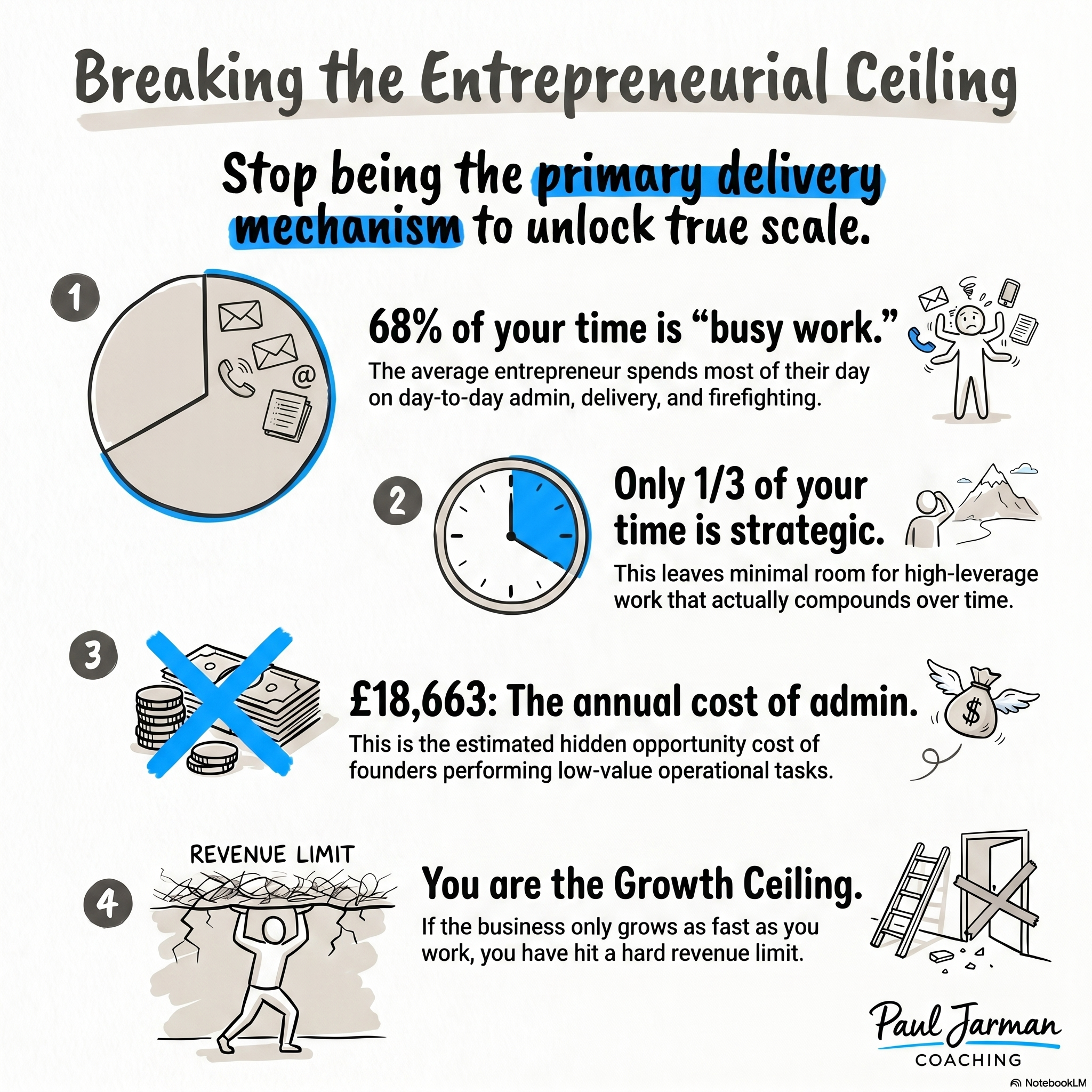
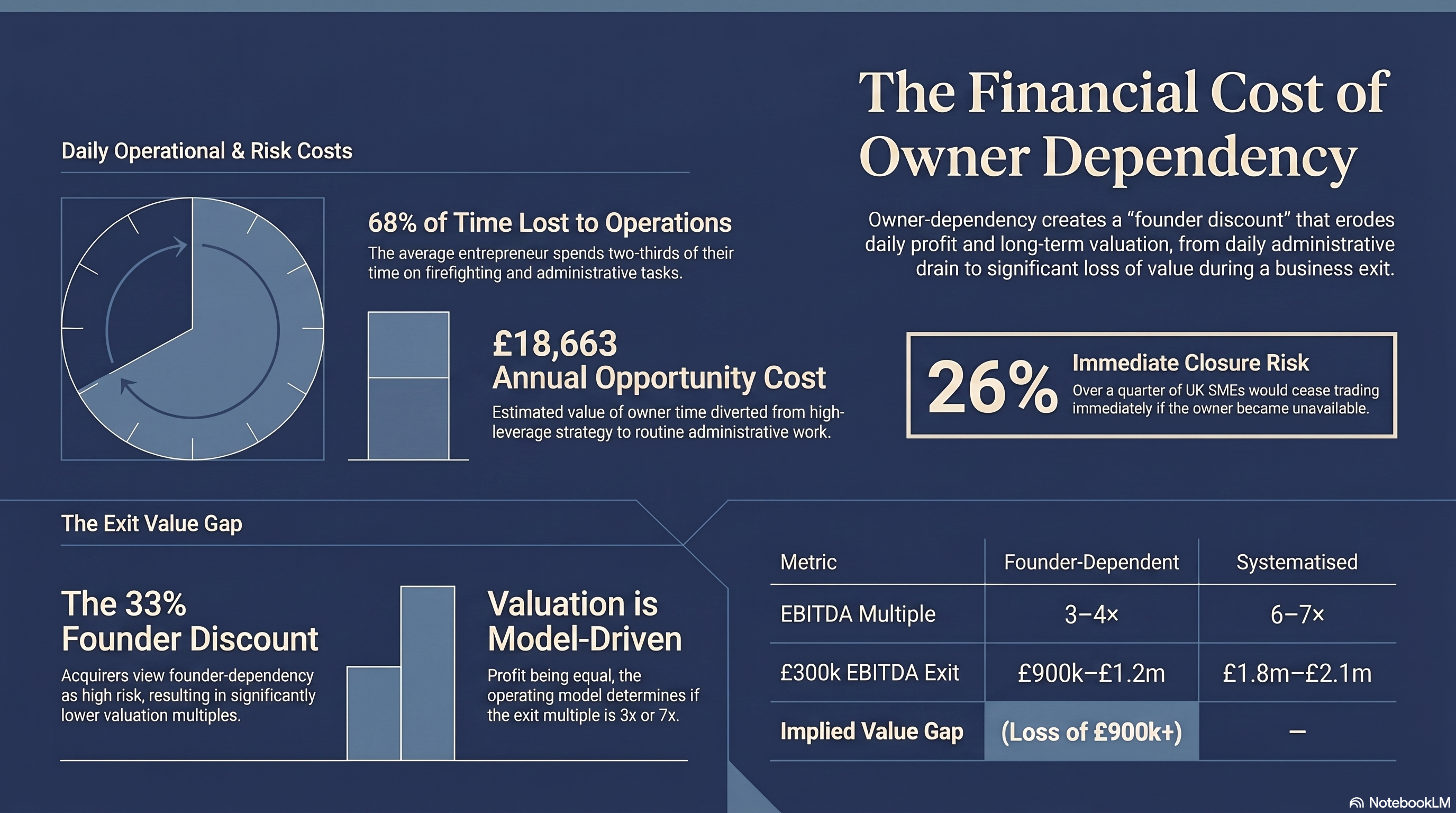
The 68% figure is worth being precise about. Research by The Alternative Board found that the average entrepreneur spends 68% of their working time on operational and day-to-day tasks — admin, firefighting, decisions that should belong to the team, delivery work that shouldn't require their direct involvement. Only around a third of their time goes on the strategic work that actually compounds.
£18,663 — estimated annual opportunity cost of admin and operational tasks per owner
NerdWallet UK Business Owners Survey, August 2025
That's the value of the time not spent on higher-leverage work — strategy, business development, the things that actually compound. It's also, notably, roughly half the cost of a year of structured operational support that could eliminate the problem entirely.
The margin impact is more concrete. When the owner is the primary delivery mechanism, the business has a hard ceiling on revenue — it can only grow as fast as the owner can work. Many businesses have been stuck at the same revenue level for two or three years not because the market isn't there, but because the operating model physically can't handle growth without the owner working more hours, which they don't have.
The 26% reality
There's a version of this cost that goes beyond the daily grind. Legal & General research into over 700 UK SMEs found that 26% would have to close immediately if a key person died or became critically ill — with a further 26% expecting to cease trading within the year.
That's not a niche finding. If your business cannot function for three weeks without you checking in, it isn't an asset — it's a fragile structure held together by your presence. That fragility has consequences beyond your own stress levels. It makes it nearly impossible to secure high-level investment or favourable lending terms. It affects your ability to attract and retain senior people who can see that the business depends entirely on one person. And it directly determines what the business is worth to anyone other than you.
The number most owners never calculate
Here's the cost that doesn't get talked about enough. And if you ever intend to sell your business — even as a distant possibility, even as a 'someday' — you need to understand this.
Businesses with high founder dependency receive a structured discount at exit. This isn't anecdotal. It's a documented feature of UK mid-market transactions.
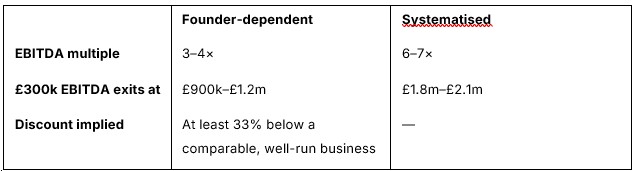
Multiple ranges reflect UK SME mid-market transaction data, 2025–26.
Sources: smebusinessvaluation.com; SE Advisors, Lower Middle Market Valuation Report 2025.
The gap between those two numbers, on the same business generating the same profit, can exceed a million pounds. That gap is entirely attributable to the operating model. Not the revenue, not the margins, not the client base — the model.
A potential acquirer looks at a founder-dependent business and sees something specific: risk. If the owner leaves, what happens to client relationships? If the owner is ill for three months, what happens to delivery? When the answer to those questions is 'not much,' the multiple reflects it. When the answers are documented processes, a capable team with defined responsibilities, and financial controls that don't route through the owner — the multiple reflects that too.
The exit that doesn't happen
There's a subtler version of this cost that affects owners who never get to an exit conversation at all. Research by Ownership at Work and the Federation of Small Businesses found that 31% of UK SME owners plan to exit within five years — but only 18% have fully established plans to do so. A lack of exit-ready systems is consistently among the primary obstacles.
These are owners who have been building something for a decade or more, who have a vague intention to eventually realise the value of what they've built, but whose business in its current form isn't structured in a way that would survive their departure.
"I'll sort the tech systems out first."
"I'll need a few more years."
"I'll do it once I've built the team up."
And the years pass, and the operating systems still aren't there, and the team is still dependent on the owner, and the exit either gets pushed further out or happens on unfavourable terms because the owner eventually runs out of runway and sells in haste.
If you have worked for ten or fifteen years to build a business and your intention is to one day realise the financial value of that work, operating as the bottleneck of that business is eroding the value of everything you've built. Every year it continues is a year the exit multiple stays where it is rather than growing.
The hidden cost in the team
There's one more cost that doesn't show up in financial projections but is real and worth acknowledging.
When a business is structured around the owner, the team's development is limited by the owner's availability. People who could become excellent operators don't, because the decisions never quite reach them. Processes that could be improved aren't, because the person with the knowledge to improve them is too busy to document it. A team that could, over time, take significant load off the owner never fully develops because the infrastructure that would allow it isn't there.
The result is a team capable of more than the business is currently using them for, and an owner who remains overloaded in part because the team hasn't been equipped to take the load. Both are losing in this arrangement, even if neither is fully aware of it.
The question worth asking
It helps to think about this not as a cost, but as an investment case. The question isn't 'can I afford to address my operating model?' The question is 'what does it cost to not address it?'
In daily terms: opportunity cost, margin limitations, time lost to firefighting. In personal terms: the health and wellbeing impact covered in the first post in this series, the cancelled evenings, the business that can never safely give you a week off. In long-term financial terms: a business worth significantly less than it should be, and that may never be ready for a sale that reflects the effort put into building it.
The question isn't whether you can afford to fix this. It's whether you can afford to keep ‘not fixing it’.
Calculate your true cost
Take a moment with these three questions:
What is your EBITDA multiple today — closer to 3× or 7×?
How many hours last week did you spend on tasks that a documented system or a team member could have handled?
Would your business be in the 26% that couldn't survive your absence for a month?
If you don't like the answers, the next piece in this series is about what it actually looks like to change the architecture — not in theory, but in practice, and in the right order.
If this is where you are
Follow along — I publish practical content on how to build a business that doesn't depend entirely on you to function. No hype. Just the mechanics of building a calmer, more profitable operation.
And if you're ready to look at the bottlenecks in your own business and what addressing them would mean for your numbers, you can book a free Clarity Call at pauljarman.coach/book-a-call-clarity.


