The Founder Dependency Tax
Most business owners don't need more motivation. They don't need a better sales funnel or a more inspired team. They need someone to tell them plainly: the thing that's stopping the business from working properly is them. Not their effort — the way the business has been built around them.
That's not a criticism. It's almost always true, and it's almost always fixable. But it doesn't get fixed until it gets named.
Before we get into how it happens, it's worth looking at what it costs.
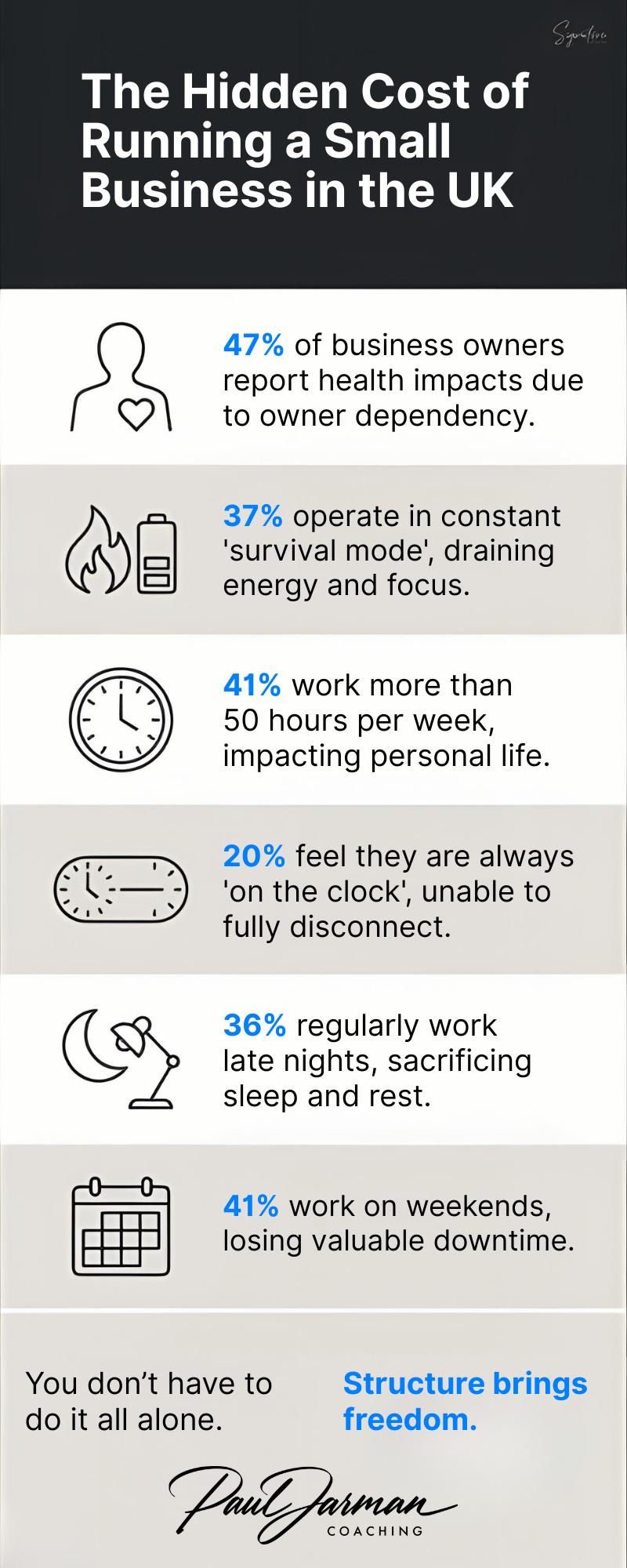
47% of UK small business owners say running their business has negatively impacted their physical or mental health.
Nearly half. And that number has been going up year on year. It's not a sample of struggling businesses or owners in crisis — it's a broad, representative survey of the kind of business owners you know. The ones who look, from the outside, like they're doing fine. And nearly half of them are telling researchers, anonymously, that the business has damaged their health.
The same survey found that 37% have experienced burnout as a direct result of running their business. That 41% regularly work up to 48 hours a week. That 20% work up to 64 hours. That 36% often work evenings. That 41% often or always work weekends.
Most of them have quietly accepted this as the cost of ownership.
Why it gets accepted — and why that's the problem
When something becomes normal, it stops feeling like a problem. It starts feeling like context.
"This is just what running a business is like."
"It'll ease off once I get through this period."
"Other owners work this hard. I'm not doing anything wrong."
These aren't irrational responses. They're adaptive. The issue is that for most owners in this position, the temporary period never ends — because the structural cause of it never gets addressed.
And the structural cause, almost universally, is the same thing: the business has been built around the owner.
What the bottleneck actually looks like
There's a version that's visible from the outside. Every problem lands on your desk. Every decision needs your input. Your team is capable and willing, but they've learned — because the system has taught them — that the fastest route to an answer is you.
There's also a version that's harder to see. You're not being approached with every small decision because your team is incompetent. You're being approached because there are no documented processes to refer to, no clear decision boundaries, no systems that allow the business to function at a consistent standard without your direct involvement. The infrastructure was never built. So it doesn't run without you.

This is what I call the Founder Dependency Tax — an invisible levy on your time, your health, and the ultimate value of what you've built.
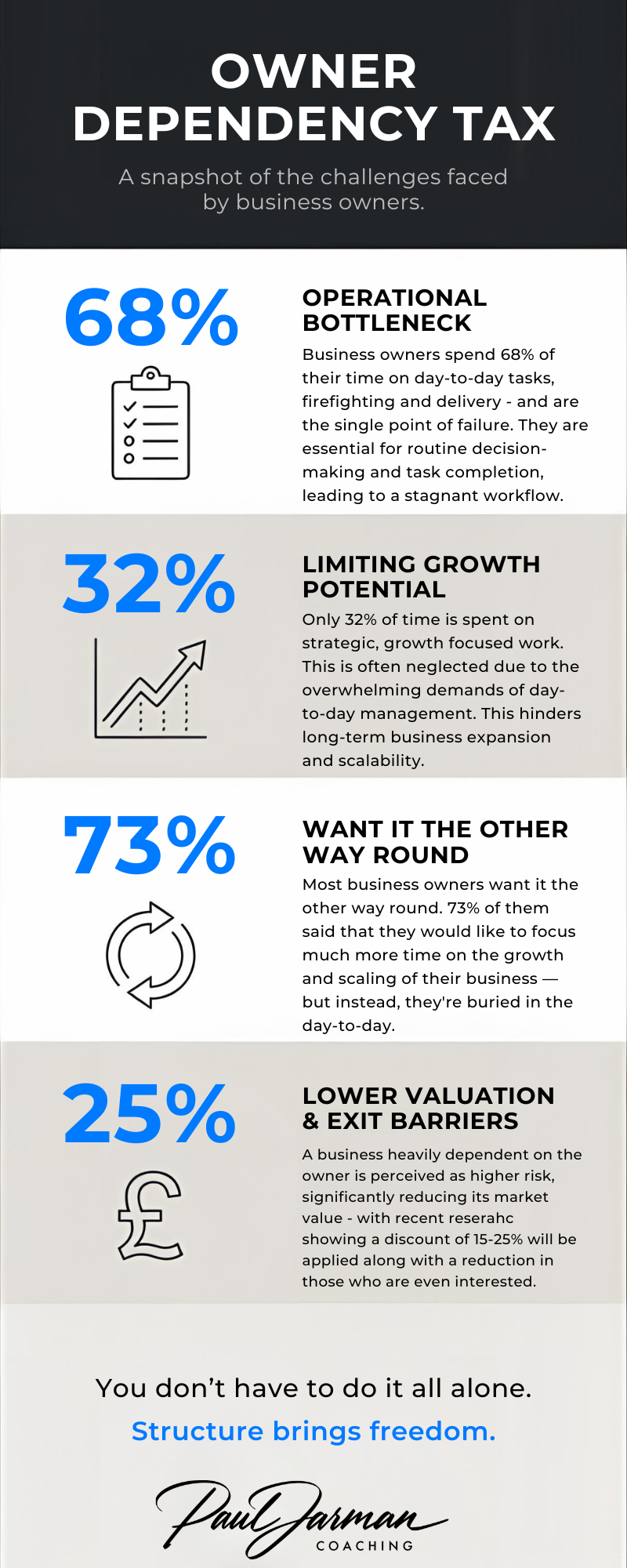
The data on time makes this concrete. Research into how entrepreneurs actually spend their time found that the average business owner spends 68% of their working hours on day-to-day tasks, delivery and firefighting — and only 32% on strategic, growth-oriented work. What's striking is that 73% of those same owners said they'd prefer the reverse.
So the vast majority of owners know the ratio is wrong. But knowing that doesn't change it, because the cause isn't awareness — it's architecture.
The cost beyond the day-to-day
For some owners, the dependency tax shows up as exhaustion and lost weekends. For others it shows up more quietly: as a business that works reasonably well, but demands more than it should, and performs below what it's capable of.
And if you're ever thinking about a future exit, the numbers are sobering. When an investor or buyer looks at a business, they aren't buying your talent. They're buying your systems, your recurring revenue, and your team's ability to deliver without you. If the secret sauce walks out every evening, risk for a buyer skyrockets.
Founder-dependent businesses receive structured valuation discounts of 15–25%. On a £2m business, that's up to £500k left on the table — not because the business isn't good, but because it can't function without one person.
Are you paying the tax? Three honest questions
If you're not sure, these tend to clarify things quickly:
–The Holiday Test. Could you go away for three weeks with no Wi-Fi and come back to a business that's larger than when you left?
–The Decision Test. What's the maximum spend your most senior team member can approve without checking with you? If it's under £1,000, you have a bottleneck.
–The Process Test. If your best employee left tomorrow, is their role documented well enough that a new hire could be 80% effective within a week?
If the answer to any of these is no, you're currently the biggest risk to your own business — not through any failing, but through a model that was built for an earlier stage and hasn't been updated since.
This is a structural problem, not a personal failing
Building a business around yourself in the early stages is often the right thing to do. It's fast, it's quality-controlled, it's how things get done when resources are limited.
The problem isn't how the business was built. The problem is when the model that got you here starts actively preventing you from getting anywhere else.
Whether you're running a seven-figure business and have become the ceiling on your own growth, or you're running a business that's doing well enough but demanding far more from you than it returns — the fix is the same. The operating model needs rebuilding.
Not a mindset shift. A structural one.
That's the work. And it's the most profitable work most business owners never get around to doing.
If this sounds familiar
Follow along — I publish practical content on how to build a business that doesn't depend entirely on you to function. No hype, no generic advice. Just the mechanics of building a calmer, more profitable operation.
And if you're already at the point where you know the model needs to change, book a Clarity Call below. We'll look at where the bottlenecks actually are and what fixing them would mean for you.


