The 68% Problem - Why Working Harder Is Making Things Worse
There's a particular type of business problem that hard work doesn't fix. The harder you work on it, the worse it gets. Most owners who are stuck are stuck here — and they don't realise it until something breaks.
Last week we looked at the human cost of founder dependency — the 47% of UK business owners whose health has been affected, the burnout figures, the normalisation of overwork. If you haven't read that, it's worth going back to first.
This week I want to go one layer deeper. Because the question that naturally follows is: why doesn't it get fixed? These are intelligent people running real businesses. They can see the problem, at least partly. Why does it persist?
The answer has a lot to do with the trap that effort creates.
The effort trap
Most business owners respond to operational problems the same way they responded to every challenge that got them to where they are: they work harder. Put in more hours. Take on more personally. Push through.
And for a long time, this works. In the early stages of a business, effort is genuinely the answer to most problems. You don't have systems yet, so you compensate with presence. You don't have a team yet, so you compensate with capacity. Effort is the business model, essentially, and it functions.
The problem comes when the business grows large enough that effort alone can't carry it — but the response to that is still...to apply more effort. At that point, the strategy that built the business starts actively limiting it.
"I've worked harder this year than any year before and made less money."
Revenue is there. Activity is high. Hours are long. And yet the returns — financial and personal — are declining. More input, less output.
This is not a motivation problem or a capability problem. It's a structural one. When a business has been built in a way that requires the owner to be the primary operating mechanism, adding more of the owner's time produces diminishing returns past a certain point — because the constraint isn't effort, it's the model itself.
What the 68% figure actually means
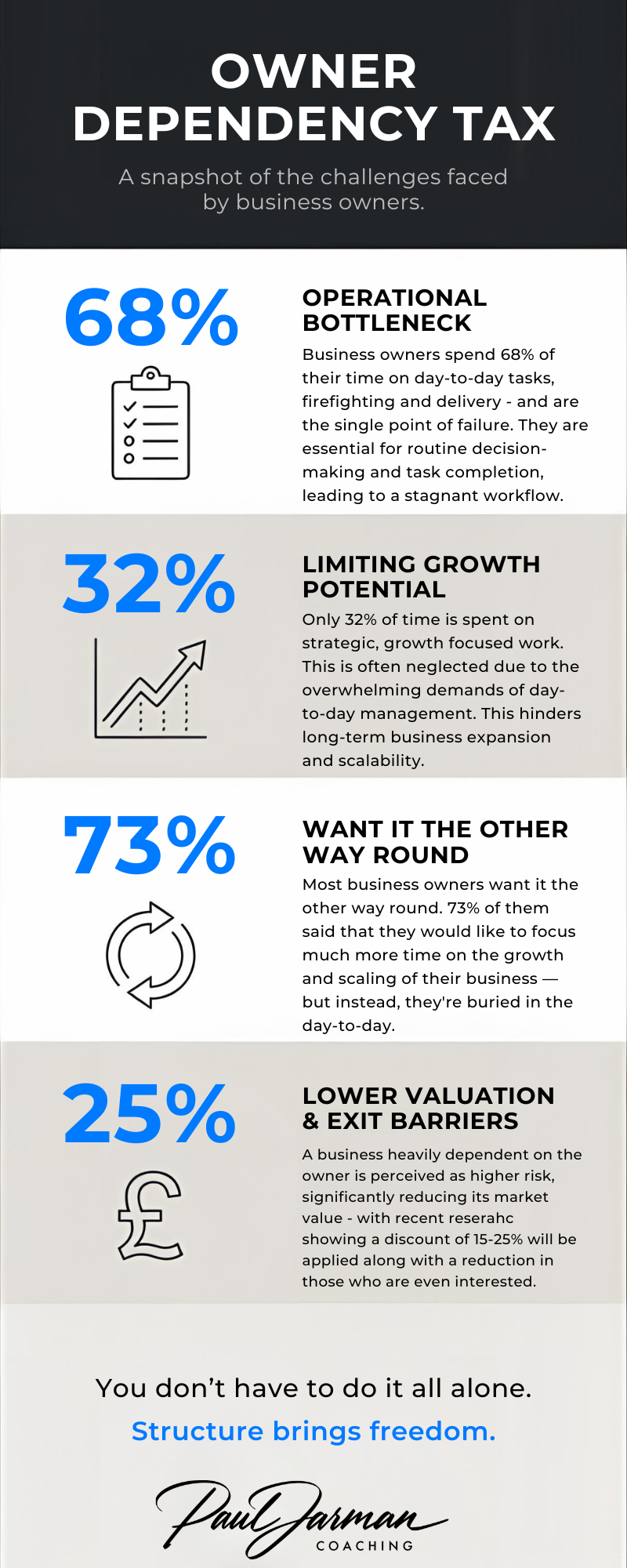
Research into how business owners spend their time found that the average entrepreneur spends 68% of their working hours on operational and delivery tasks — the day-to-day running of the business — and only 32% on strategic work. And crucially, 73% of those owners said they'd prefer the ratio to be the other way around.
That gap between how owners are spending their time and how they want to be spending it is worth sitting with. It's not a small gap. It represents the majority of the working week being consumed by activity that, in a well-structured business, would either be handled by others or would simply not need to happen at all.
£18,663 — estimated annual opportunity cost of admin and operational tasks falling to the business owner. (NerdWallet UK Business Owners Survey · 2025)
That's not the cost of doing the admin. That's the cost of not doing the things the owner could have been doing instead — the strategic, growth-oriented, higher-value work that only they can do.
And that figure only captures opportunity cost. It doesn't capture the cost of decisions made badly because the person making them is exhausted. It doesn't capture the cost of growth not pursued because there was no capacity to pursue it. It doesn't capture what happens to team performance when the person they all escalate to is running at 130% and doesn't have the bandwidth to develop them.
Why hiring more people doesn't fix it
The intuitive response to an overloaded business owner is to bring in more resource. Hire someone. Delegate. And there's merit in that thinking — but it consistently fails to solve the problem when the underlying model hasn't changed.
If the issue is that the owner is involved in too many decisions and too much of the delivery, hiring another person into a business with no documented processes and no clear decision boundaries doesn't reduce the owner's load — it increases it. Now they're managing someone else while still doing everything they were doing before, plus handling the questions that come with onboarding a new person.
This isn't a hiring mistake. It's an infrastructure mistake. The business wasn't ready to leverage the hire because the operational foundations weren't in place to support it.
The firefighting cycle
There's a particular dynamic that becomes self-reinforcing once a business reaches a certain size without operational structure in place:
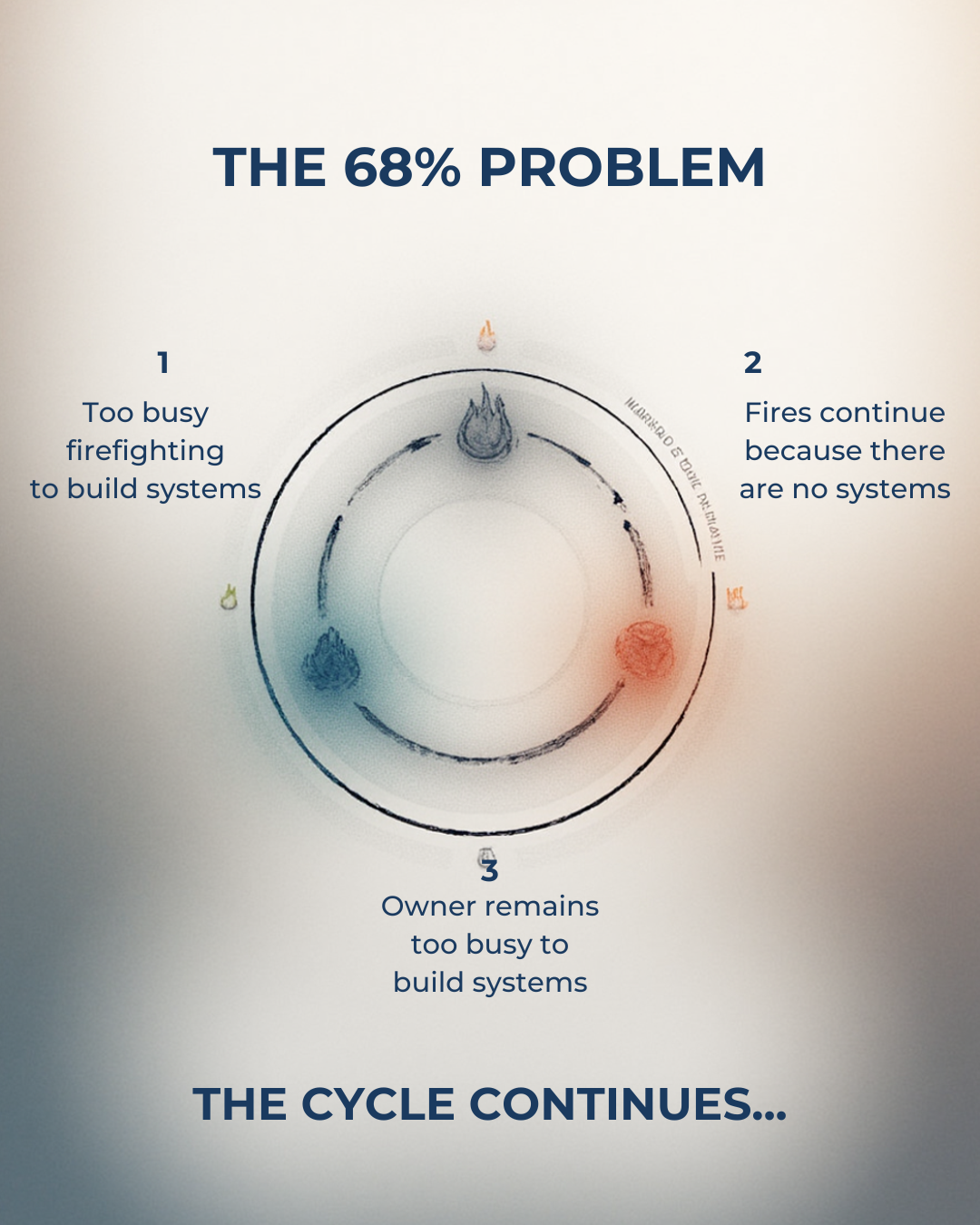
The owner is too busy firefighting to build the systems that would stop the fires. The fires continue because there are no systems. The owner remains too busy to build them.
Each rotation leaves the owner slightly more exhausted and slightly less confident that change is possible. What makes this particularly insidious is that the firefighting often looks like productivity from the inside. You're busy. You're solving problems. Things are moving.
It's only when you step back — if you ever get the chance to step back — that you notice the same fires are recurring, the same types of problems are landing on your desk, and the same conversations are happening on repeat. The business isn't progressing. It's cycling.
What actually needs to change
The shift required isn't a motivational one. It's about changing the operating model so that the business is no longer structurally dependent on the owner's direct involvement in day-to-day decisions and delivery.
That means documented processes. Clear decision boundaries. A team that has the information and authority it needs to operate without constant escalation. Systems that produce consistent outputs regardless of who's doing the work.
None of that is complex in principle. In practice, it requires the owner to step back from the delivery long enough to build the infrastructure — which is extraordinarily difficult when the delivery is consuming 68% of their week. This is why most owners don't do it on their own. Not because they lack the capability, but because they lack the time and the external structure to hold them to it.
The SCALE framework: architecture over adrenaline
To move from technical expert who does everything to owner who leads an operation, you need a framework that replaces your presence with process. This is what I use with every client.
1. Strategy — setting the guardrails
Most owners confuse strategy with goals. A goal is 'I want to make £1m.' A strategy is the set of choices that makes that goal inevitable — including what you choose not to do. When you have a clear strategy, your team knows what to say no to without asking you.
Result: Fewer interruptions and more alignment.
2. Capacity — finding the hidden hours
Usually the answer isn't more people — it's fixing how time is being used. We look at where hours are being lost and install time-recovery systems that reclaim space for the owner to think and lead rather than deliver.
Result: Immediate relief from overwhelm and room to operate differently.
3. Amplify Profit — efficiency equals margin
Scaling isn't just more revenue — it's more profit. If the operations are messy, every new client adds complexity and cost, meaning margins actually shrink as you grow. We tighten the delivery engine.
Result: Higher margins without increasing personal workload.
4. Leverage Systems — replacing logic with process
This is where we build the machine. We move the knowledge out of your head and into a living operating manual, so the business runs consistently regardless of who's doing the work.
Result: A business that runs predictably, even when you aren't there.
5. Enjoyment — the point of all of it
What's the point of a business that works if the owner doesn't enjoy it? The final stage is about reclaiming your role — not just as a business owner, but as a person with a life that the business is meant to serve.
Result: Time, energy, and clarity returned to the owner.
Where to start: the Decision Audit
The good news is that the shift doesn't have to be wholesale. Small structural changes in the right order create compounding time returns. The best place to start is with what I call a 'Decision Audit'.
Every time a team member comes to you with a question they should be able to answer themselves, it's a sign of a missing system. They aren't asking because they're incompetent — they're asking because the logic hasn't been documented anywhere. The knowledge is in your head, not in the business.
For one week, keep a tally of every time someone asks you for a decision or an approval. At the end of the week, look for the patterns:
· Which of these decisions are recurring?
· What criteria do you use to make that decision?
· Could that criteria be written down so the team can make it themselves next time?
Once you've identified a recurring decision, do this:
Document the logic you use to make it.
Hand that logic to a team member and make them the owner of that decision.
Don't take it back.
That's the beginning of an operating model. Each piece of logic you move out of your head and into the business is a small structural fix. Multiply that by a hundred and you have a business that runs without you needing to be the answer to everything.
The motivation people are looking for usually arrives after they have a system that works — not before. But it starts with being honest about the problem. The business has been built in a way that requires you to be present for everything. The first step is changing that architecture, one piece at a time.
If this is where you are
Follow along — I publish practical content on how to build a business that doesn't depend entirely on you to function. No hype. Just the mechanics of building a calmer, more profitable operation.
And if you're ready to look at where the bottlenecks actually are in your business and what fixing them would mean for you:


